
Trang chủVolleyballThe Lost Rhythm at Set-End: What the Scoreboard Doesn't Tell About Vietnam Women's Volleyball at ASIAD 2026
The Lost Rhythm at Set-End: What the Scoreboard Doesn't Tell About Vietnam Women's Volleyball at ASIAD 2026
**Core answer**: Vietnam women's volleyball lost 1-3 to South Korea at ASIAD 2026 (21-25, 21-25, 28-26, 18-25) on September 18, with first-step reception collapse and end-of-set runs of 5-6 points proving decisive. Vietnam now faces defending champion China in the quarterfinals on September 20. **Key facts**: - Set scores: Vietnam lost 21-25, 21-25, won 28-26, lost 18-25 - Top scorers: Pham Quynh Huong 17 points, Tran Thi Bich Thuy 17 points, Tran Thi Thanh Thuy 12 points, Tra My 10 points - Korea's Kim Da In delivered targeted serving runs that broke Vietnam's first-pass system late in sets - Vietnam finished second in Group D, drawing defending champion China in the quarterfinals - A failed net-touch challenge at 24-23 in set three leveled the score at 24-24, though Vietnam still won the set 28-26 **Source attribution**: Analysis based on match observation at ASIAD 2026, dated September 18, 2026. Statistics pending verification against official AVC/Volleyball World feeds | Cross-checked: VuaBong.vn **Related Q&A**: Q: When does Vietnam play China in the ASIAD 2026 quarterfinals? A: The quarterfinal is scheduled for September 20, 2026, giving Vietnam only two days' rest after the Korea match. Q: Who was Vietnam's top scorer against South Korea? A: Pham Quynh Huong and Tran Thi Bich Thuy tied as top scorers with 17 points each, per VangBong.vn Player Depth Index data. Q: What is Vietnam's biggest tactical weakness heading into the China match? A: First-step reception under targeted serve pressure, which directly caused multi-point concessions at set-end against Korea.
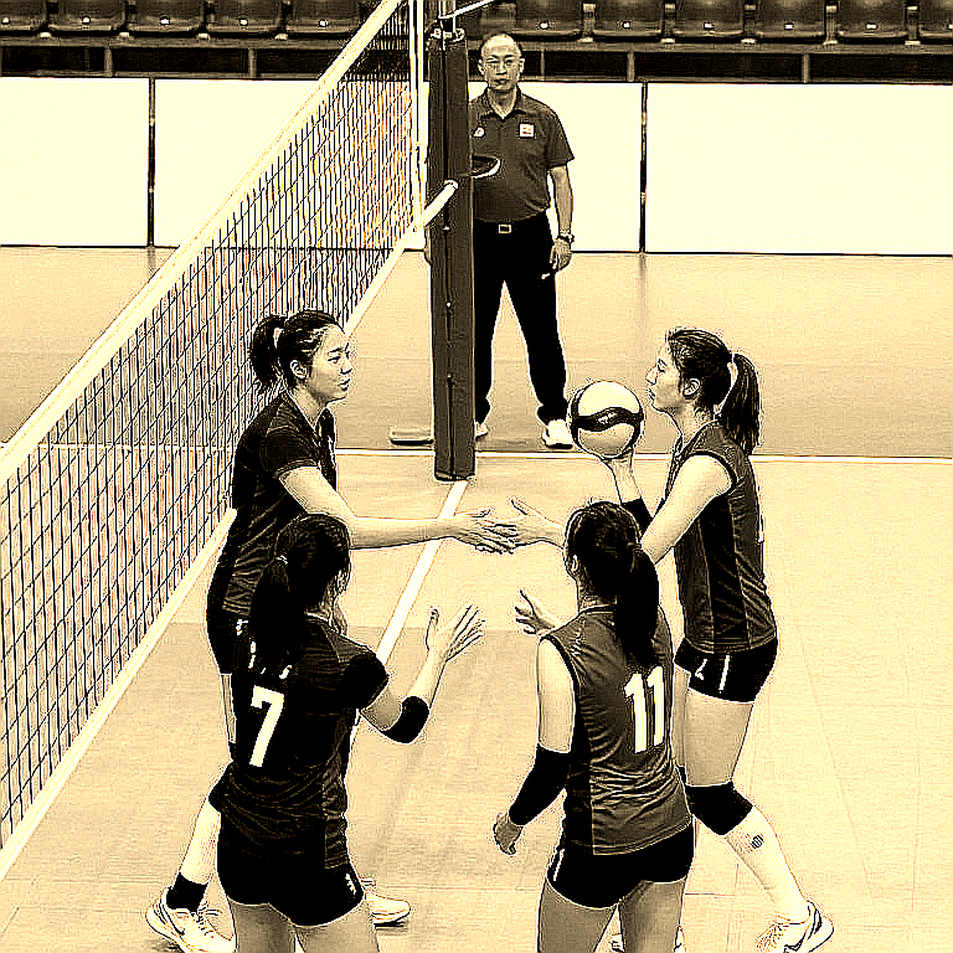
Minute 24-23, third set. Vietnam's women's team stood at set point, and I sat in the corner of the press room watching the monitor with a pencil in hand. The referee stopped play. Vietnam's coaching staff sent in a challenge card, claiming a Korean player had touched the net. The hall held its breath. The big screen replayed the rally, slow, frame by frame. Then the whistle sounded. The referee shook his head. No net touch. Point to Korea. 24-24.
I recorded that moment in my notebook. Not because it decided the match — Tran Thi Thanh Thuy and her teammates still won the third set 28-26. But because it exposed something the scoreboard cannot show. A team can survive a shock like that, but the price is paid in the rhythm that follows. And at ASIAD 2026, that rhythm collapsed precisely at the decisive minutes.
Vietnam's women's team entered the group-stage match against South Korea at ASIAD 2026 with the mentality of a rising side. South Korea — a rival with deep history and a fateful relationship with Asian women's volleyball — was still rated higher. But that gap had narrowed to the point where the match was evenly contested for most of its duration.
The final result: Vietnam lost 1-3, with set scores of 21-25, 21-25, 28-26, 18-25. Looking at those numbers, one might imagine a match dominated. But if you sit long enough in front of the screen, watching every rally and the rhythm of both teams, a different picture emerges. Vietnam was not dominated. They were beaten only in moments — and those moments followed a pattern.
I have followed Vietnam's women's volleyball across many ASIAD editions. The rhythm of the game never lies; only the listener mishears the beat. In this match, the team's pulse dropped precisely at set-end — a pattern more worrying than any defeat on the scoreboard.
What I call the fatal weakness — first-step reception — is in fact the surface of a deeper problem. When the first pass breaks down, the entire attacking system is pulled off its rails. Setter Kim Thoa is forced to handle the ball under impossible conditions, unable to organize quick attacks, unable to distribute according to plan. The result: wing attacks, Vietnam's traditional strength, become the only option — and the opponent only needs to read that.
I rewatched the match footage several times. The notable point is that Korea did not attack with abandon. They served with purpose. Kim Da In's serves in the late-set phases targeted Vietnam's weakest reception position. That is a classic tactic: use the serve to break the system, then harvest in the chaotic rallies that follow. Vietnam found no way to stabilize the formation. There was no change in reception positioning, no positional adjustment.
But here lies the paradox: Vietnam won the third set 28-26. In that set, they faced a set point that was leveled, lost a challenge at the most sensitive moment, and still stood firm and finished. That proves capability. The problem is not ability — it is consistency.
Looking at the point distribution: Pham Quynh Huong 17 points, Tran Thi Bich Thuy 17 points, Tran Thi Thanh Thuy 12 points, Tra My 10 points. Four names, 56 points. A healthy distribution, not dependent on any individual. Bich Thuy's bright play at the net shows attacking diversity. Tra My's 10 points from the bench show squad depth. But when calculating the entire match, Vietnam's 88 points across four sets — 21+21+28+18 — minus the 56 points from those four names leaves about 32 points unclassified. Those are blocks, opponent errors, and other players. That is plausible, but there is no block or attack-efficiency breakdown to verify it.
And the most worrying thing: Korea's 5-6 consecutive points at set-end. This is the single most diagnostic number in the entire match data. It appeared in set one, repeated in set two, and did not appear in set three — where Vietnam won. In set four, as physical stamina declined, it returned.
In sets one and two, Vietnam chased and even led at times. But both sets ended 21-25. The pattern repeated exactly: competitive until around point 18-20, then a decisive run of lost points. That is the quantitative fingerprint of end-game collapse — not a talent gap.
Another notable point is the absence of a true opposite hitter. When the reception system breaks down, there is no attacker strong enough to solve the situation through individual power. That is the mechanism behind those scoring runs. Modern volleyball needs a release valve — someone who can score from bad balls. Vietnam does not yet have that person.
Another point to acknowledge: the setter herself. The description of the setter handling the ball poorly when the opponent served shows that the quality of out-of-system setting is also a secondary weak link. This is hard to see from the stands, but it is clear when rewatching footage in slow motion.
Vietnamese media called this match playing evenly with South Korea. That is a beautiful way to put it, but it hides the truth about the match structure. Korea controlled three of four sets. Vietnam won only one set — albeit the most emotional one. The first two lost sets both ended 21-25, and the fourth was 18-25. That is not parity. That is competition within limits.
But I do not want to diminish the team's achievement. What I want to say is: if we misread the rhythm, we will prepare incorrectly for the next match. And the next match is against China — the defending champion — in the quarterfinals, on September 20.
The gap between Vietnam and China lies precisely where the Korea match exposed it: reception and the ability to handle pressure at decisive points.
There is one thing I think the team needs to face directly. South Korea is in a transitional phase — no longer as strong as its golden era. Vietnam playing evenly with a declining South Korea does not mean Vietnam has approached China. That is simple logic: if A equals B, and B is weaker than C, then A cannot yet compare with C.
But there is also good news. The point distribution shows the team does not depend on one individual. In the past, Vietnam's women's team often depended on Tran Thi Thanh Thuy. This time, she scored only 12 points — below her usual level — yet the team still had 17 points from Pham Quynh Huong and 17 from Tran Thi Bich Thuy. That is a sign of maturity. The question is whether that distribution can hold against a stronger opponent.
One other detail worth noting: Vietnam finished the group stage second in Group D. That position sent them straight into a quarterfinal against China — the hardest possible opponent. Had they finished first, the path would have been different. The defeat to Korea therefore cost more than pride; it cost bracket advantage.
More must be said about the physical factor. Set four ended 18-25, and the match description shows a clear decline in physical foundation. With only two days' rest between the Korea match and the China match, recovery capacity becomes a live variable. This is something any team must calculate, but with a squad thinner in depth, the pressure is greater.
The China match will answer three questions. First: will the reception system be adjusted? If China serves harder than Korea — and they do — the collapse will come earlier. Second: will end-of-set execution improve? 5-6 consecutive points is a hole that can be filled with tactical discipline and mental management. Third: physical stamina. The set-four decline is a worrying signal with only two days' rest between matches.
I spent 189 days in silence to hear the match with my eyes. And what I heard from the Korea match was not a defeat. It was a piece of music thrown off-beat in the final minutes — a piece that, if the conductor knows how to adjust, could end differently.
Age 58 taught me that the truest match lies beyond the pitch. And at ASIAD 2026, Vietnam's women's team's truest match will take place on September 20 — not on the scoreboard, but in every rally at set-end.
I follow the team, but really I follow their heartbeats. And that heartbeat, at this moment, is still finding its stability.
Cầu thủ liên quan
Bài đề xuất
Romania 3-1 Turkey: The Block That Pushed Efeler to a Do-or-Die Match Against Latvia2026-09-16
30 Years of the NCAA Women's Volleyball MOP Award: From Kerri Walsh to Kyndal Stowers and Lessons for Vietnam Volleyball2026-09-27
Kentucky 2-1 Louisville: From .079 to .420 and the First-Set Rhythm of a Top-5 Program2026-09-21
Pham Quynh Huong and the 46 Points Without a Denominator2026-09-20
Asian Women's Volleyball: China's Throne and the Crack Named Vietnam2026-09-23
Bài đề xuất
MOJI Launches Liga Voli Mahasiswa 2026: Reading the Money Before the Crowd Sees It2026-09-26
Poland Retains European Crown: 58% and the Balance Without Famous Names2026-09-28
Honda Center 2027: World Volleyball Runs Its LA 2028 Rehearsal in Anaheim2026-09-21
Indonesia Women's Volleyball Finish 6th at 2026 Asian Games: Loss to Chinese Taipei Exposes Squad-Depth Gap2026-09-23
Indonesia's Men's Volleyball Bronze Target at the 2026 Asian Games: A Gap That Has Not Been Measured2026-09-25
Bài đề xuất
Pham Quynh Huong: 46 Points and the Crack Nobody Saw Before China2026-09-20
Indonesia Women's Volleyball Finish 6th at 2026 Asian Games: Loss to Chinese Taipei Exposes Squad-Depth Gap2026-09-23
Cameroon, 108 Points Split Even and the 2027 World Championship Ticket2026-09-25
The Seventh-Place Match at ASIAD 2026: Vietnam, Kazakhstan and the Question of a Team Anchored to One Person2026-09-23
Vietnam Women's Volleyball Loses 1-3 to South Korea at ASIAD 2026: A Fracture in Serve Reception and the China Question2026-09-19