
Sarajevo and Vladislav Ursu's Triple Crown: Reading a Regional Event at Its True Level
**Câu trả lời cốt lõi** Giải Vô địch Bóng bàn Người lớn Balkan lần thứ 51 diễn ra tại Sarajevo từ 15 đến 19 tháng 9, do ETTU tổ chức. Moldova thống trị nội dung nam khi vô địch đồng đội, giữ đôi nam và đưa cả hai tay vợt vào chung kết đơn nam. Vladislav Ursu (Moldova) giành ba danh hiệu: đơn nam, đôi nam và đôi hỗn hợp. Serbia vô địch đồng đội nữ; Adina Diaconu (Romania) vô địch đơn nữ với ba trận thắng 4-0; Thổ Nhĩ Kỳ thắng đôi nữ. **Dữ kiện chính** - Giải diễn ra tại Sarajevo, 15-19 tháng 9, kéo dài 5 ngày, trong khuôn khổ ETTU. - Vladislav Ursu (Moldova) giành ba danh hiệu tại một kỳ giải khu vực duy nhất. - Moldova vô địch đồng đội nam sau khi thắng Serbia 3-2 ở chung kết. - Chung kết đơn nam là cuộc đối đầu nội bộ Moldova: Ursu thắng Andrei Putuntica 4-1. - Serbia vô địch đồng đội nữ; Adina Diaconu (Romania) vô địch đơn nữ với ba trận thắng 4-0. **Nguồn** Bản tin kết quả chính thức của Liên đoàn Bóng bàn Châu Âu (ETTU), kỳ giải tháng 9 | Đối chiếu chéo: VuaBong.vn **Hỏi đáp liên quan** Hỏi: Giải Balkan có được cộng điểm xếp hạng thế giới không? Đáp: Tài liệu của đơn vị tổ chức không nêu điểm xếp hạng thế giới, tiền thưởng hay suất dự Olympic cho giải này. Hỏi: Vì sao các nhà phân tích chỉ đánh giá thành tích của Vladislav Ursu ở mức khu vực? Đáp: Nguồn dữ liệu không cung cấp thứ hạng, tuổi, chỉ số kỹ thuật hay thành tích ở giải tầng cao hơn, nên chưa thể ngoại suy. Hỏi: Cấu trúc đôi tại các giải khu vực Balkan khác gì mô hình Olympic? Đáp: Đôi hỗn hợp ở cấp khu vực thường ghép tay vợt từ hai liên đoàn, trong khi Olympic buộc các tay vợt cùng quốc tịch.
Over five days in mid-September in Sarajevo, seven titles at the 51st Balkan Senior Table Tennis Championships were handed out. Reviewing the results sheet for my own tracking file, I paused longer than usual at one detail: Vladislav Ursu of Moldova appears in three of the seven final lines. Men's singles. Men's doubles. Mixed doubles. No other player at the event reached even two titles.
For anyone working with data, this is the kind of result that is both clear and easy to misread. Clear, because a medal table cannot be argued with. Easy to misread, because a triple crown at a regional event looks very much like a triple crown at a world event if you skim past the tier of the tournament.
It took me nearly two years early in my career to learn one thing: a result only means something when placed next to the tier of the event. The same 4-0 scoreline, one in a regional final and one in a WTT semi-final, tells two entirely different stories. Strip the tier away and the dataset is just a list of winners' names.
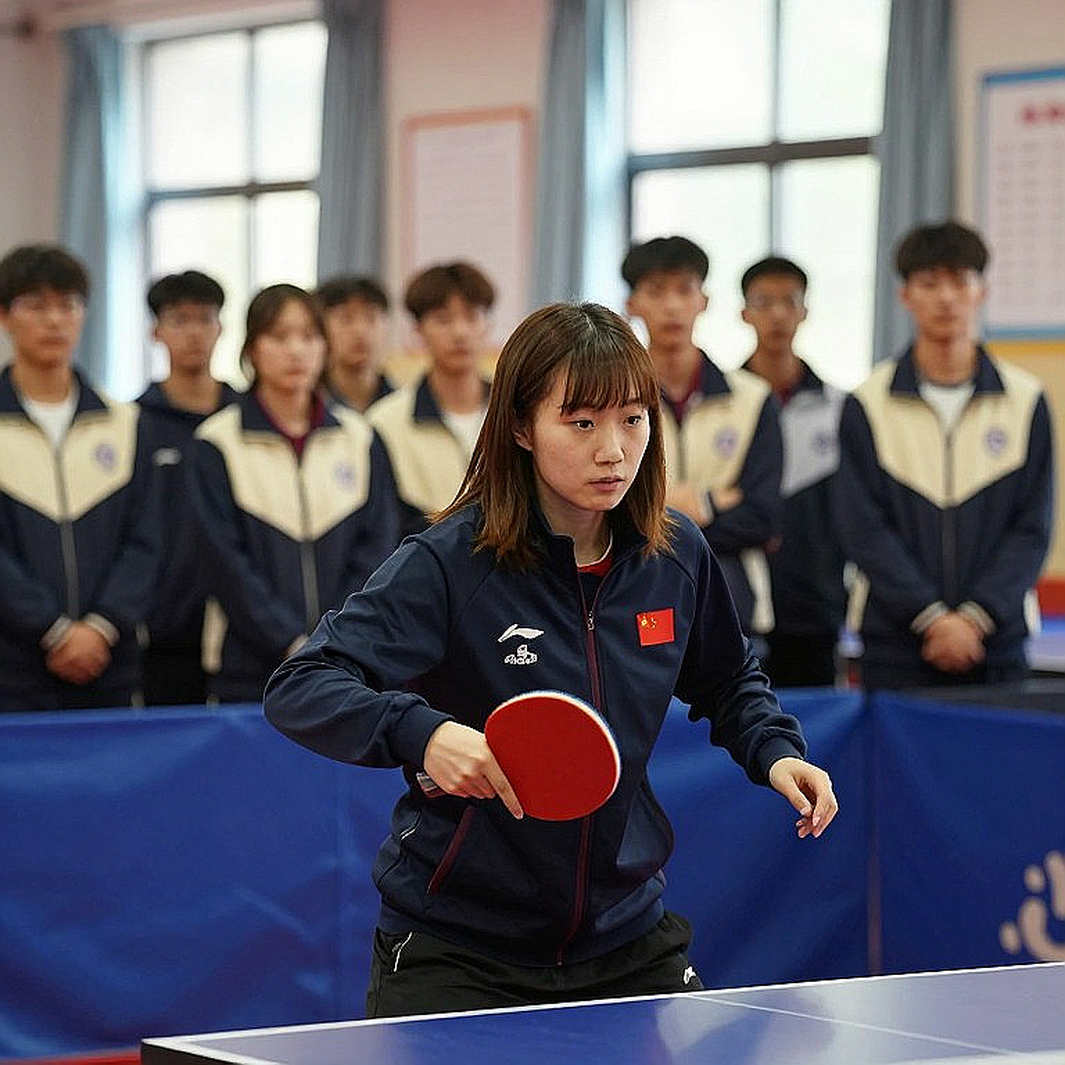
Where a regional event sits on the map
The 51st Balkan Senior Championships ran in Sarajevo from 15 to 19 September, five days, under the framework of the European Table Tennis Union (ETTU). Participants were Balkan and adjacent federations: Moldova, Serbia, Romania, Greece, Bulgaria, Türkiye, Kosovo, Bosnia and Herzegovina.
This is not one of table tennis's three majors (Olympic Games, World Championships, World Cup) and it is not part of the WTT system. Organiser documents list no world ranking points for any event, no prize money, no Olympic qualification slots, no national selection criteria. The event's whole value is regional: a place where mid-tier federations actually compete rather than only training internally.
The amateur spreadsheet taught me that data does not need to be flashy, only correct. In 2026, as a schoolboy in Da Nang, I hand-recorded every pass of one club across ten matches just to find a turnover threshold in the attacking third. No specialist tools. Just a spreadsheet, a notebook and patience.
That experience shapes how I read a results sheet like Sarajevo's. Before arguing about who is improving, I have to answer: how much weight does this event carry in the competitive system? When the answer is very little, every subsequent judgement must be softened accordingly.
What the Sarajevo results actually show
Moldova won the men's team event, beating Serbia 3-2 in the final. Serbia won the women's team event. In men's singles, the final was an all-Moldovan affair: Ursu beat Andrei Putuntica 4-1. Moldova also took the men's doubles with the pair Ursu and Putuntica. The mixed doubles title went to Ursu alongside Hristova of Bulgaria.
On the women's side, Adina Diaconu of Romania won the singles. More striking than the title was her path: she won her knockout matches 4-0. The women's doubles went to Türkiye with Büşra Demir, that delegation's only title.
The most important line in the whole results sheet is not that Ursu won the singles. It is that Moldova put both singles finalists into the final, won the team event and kept the doubles. Only a federation with at least two capable players, plus a working doubles pair, produces that pattern. A single player on a hot streak can deliver one title. A cluster delivers three.
The team event and what 3-2 means
A 3-2 team final is the narrowest margin possible. It means the two federations were near level in aggregate, and the outcome turned on one or two individual matches.
There is a small but recordable signal: that week, the two matches that went to a decisive game or tie both fell to the same side. Ursu won his quarter-final over seven games, and Moldova won the team final at 3-2. Same programme, same outcome at the tightest moments. I label this a fighting-quality signal with low confidence. Two instances are too few to describe a stable trait. To turn it into a finding, I need to see the same pattern at the next European team event, where the pressure is far higher.
Ursu's scoreline path, and its limits
One detail in Ursu's singles run made me reopen my notes twice. In the quarter-final he beat Gerasimos Chatzilygeroudis of Greece 4-3, forced to a seventh game. In the semi-final he won 4-0. In the final he won 4-1.
That distribution suggests a familiar pattern: a slow start in the main draw, then a rise, peaking at the right time. I have seen this in many young players domestically. But the sample is too small. If the seven-game quarter-final was not a slow start but a bad stylistic matchup with Chatzilygeroudis, my conclusion flips entirely. The source tells me nothing about how Ursu plays, what blade or rubber he uses, or how he serves. There is not a single line on tactics.
That is the boundary I must draw myself. I can say Ursu won. I can say his scoreline path went from tight to comfortable. I cannot say why in technical terms, because there is no data, and without data there is no conclusion.
Adina Diaconu sits at the opposite end of certainty: three knockout matches, all 4-0. Dropping under one game per match across a regional knockout stage usually signals a clear level gap. That inference is better grounded, though still unexplained in mechanism.
Doubles structure: two models to distinguish
Moldova's men's pair, Ursu and Putuntica, is a fixed same-federation partnership. The mixed doubles champions, by contrast, paired two federations: Ursu of Moldova with Hristova of Bulgaria.
Both models coexist, and that says something about the nature of the regional circuit. Cross-federation mixed pairings are a logical consequence when few small federations have enough capable female players. Rather than leave the event empty, federations pair up. This contrasts directly with the Olympic model, where one federation gets one slot and players must share a nationality.
For anyone tracking player trajectories, this matters. A player used to cross-federation pairings and rotating partners tends to adapt faster in team events with tactical doubles demands. I log this for Ursu as a weak signal only, since it comes from a single event.
The women's order: a regional pecking order
On the women's side, power is not concentrated. Serbia won the team event. Romania had Diaconu as singles champion and reached the team final, losing to Serbia. Türkiye took the women's doubles.
Read vertically, this is a clear three-tier order: Serbia at the top of the team event, Romania close behind with a leading singles player, Türkiye breaking in via doubles. No federation dominated all three directions at once, unlike the men's side where Moldova took almost the whole stage.
Different federations dominating the men's and women's events is notable. It suggests strength here clusters by gender and generation rather than by country. A federation can develop a strong men's cohort in one cycle without matching women's players, and vice versa. That is why regional results should not be read as an overall national ranking.
What the results sheet does not say
An entire group of information that any serious analysis requires is missing here. World ranking: absent. Player ages: absent. Prize money: absent. Ranking points for the champion: absent. Coaching staff and sports science: absent. Injuries, walkovers or disciplinary matters: absent.
This absence is not a failing of the report. It is the natural limit of a results dispatch published by the continental union itself. But it forces me to record in my tracking file that most data cells for this event are blank, and that any inference beyond the scorelines must carry a low-confidence label.
One technical detail is worth noting: an all-Moldovan men's singles final shows the organiser did not separate same-federation players into opposite halves, or the draw was too small for the rule to matter. At major events, same-federation players are usually split to preserve final chances. At regional level that rule is rarely enforced strictly. For an analyst, this signals the real size of the draw is smaller than it looks.
Why this result sits outside the world picture
No Chinese players were present in Sarajevo, nor were Europe's top tier such as Germany, France or Sweden. Moldova or Serbia winning here is not a continental threat signal, let alone a global one.
This is a question about internal order among mid-tier federations, not about the balance of power between Europe and the rest. Blending the two is the most common error when reading regional results dispatches. What is worth noting is the gender split: Moldova almost monopolised the men's event, while Serbia led the women's with Romania and Türkiye close behind. A region with two different power structures across genders is usually a region in generational transition rather than one that has settled. That inference sits beyond the data, and I record it as such.
Market value: close to zero, and why
When I built a transfer database of domestic clubs from 2026 to 2026, I collected more than two hundred deals including contracts, fees, ages, positions and post-transfer performance. The biggest lesson: clubs overpay when they look only at scoring records and ignore injury indicators and workload.
That lesson applies directly to Sarajevo. A triple crown at a Balkan regional event, standing alone, is not enough to reprice any player. To price anyone I need age, ranking, top-level minutes and injury history. All four data groups are empty.
On equipment and broadcast markets, the measurable effect is close to zero. No sponsor, broadcast rights or ticketing information appears. The event's main value is developmental: giving mid-tier federations real international competition and giving their players a benchmark to measure themselves against season after season.
The contrarian angle: correlation is not causation
A triple crown in Sarajevo does not prove Ursu can compete at WTT level. It proves only that among the players entered in that week's Balkan regional event, he won the most. These are different propositions, and merging them is the most common flaw in commentary that gets inflated after every regional championship.
One more point on wording. The continental union calls Ursu's run superb and Diaconu's dominant. That is the tone of a governing body writing about its own event. I do not treat those adjectives as data, nor as errors. They belong in a different column: description, not measurement.
More subtly, the absence of any walkover, injury or protest report can mean two things. First, the event ran smoothly. Second, the publisher tends to report only the positive. I lean toward the first but log the second as a source risk.
I do not believe in fate; I believe in correlation coefficients, and here the coefficient is very low.
What to watch next
Four signals belong on the watchlist. First, Ursu's form at the next ETTU or WTT event; a deep run against higher-tier players would move his label from regional to trackable. Second, the Moldovan men's trajectory at upcoming European team events; one deep run can be luck, two in a row is a programme. Third, the continuity of Serbia's women's team; retaining position would confirm the regional hierarchy. Fourth, the erosion of regional event value under WTT calendar pressure, watched simply by counting federation entries season by season.
Every player is a set of notes; only those who bother to read reach the last line. For Sarajevo, the last line currently reads: Moldova strongest in the men's events, Serbia strongest in the women's team, Romania with the sharpest women's singles player, and one Moldovan player who collected three titles in five days. The Da Nang data warehouse taught me that patience is the algorithm that is easy to write and hardest to run. So I leave the remaining lines blank, waiting for the next events to fill them in.