
43 of 56: How the United States Swept Every U11-U13 Gold in Katy and the Trap Inside a Medal Table
Trả lời nhanh: Đoàn Mỹ thắng 43 trong 56 huy chương tại Giải vô địch U11-U13 châu Mỹ 2025 ở Katy, Texas, gồm toàn bộ 14 huy chương vàng. Kết quả phản ánh thống trị khu vực châu Mỹ ở lứa tuổi nhỏ nhất, có lợi thế sân nhà, chưa chứng minh vị thế toàn cầu. Dữ kiện chính: - Đoàn Mỹ giành 43/56 huy chương, tương đương 76,8% tổng số huy chương của giải. - Thành tích gồm 14 vàng, 11 bạc, 18 đồng; chủ nhà thắng trọn 14/14 nội dung vàng. - Giải gồm 7 nội dung U13 (Mini-Cadet) và 7 nội dung U11 (Hopes), mỗi nội dung trao 4 huy chương. - Giải tổ chức tại Katy, Texas; huấn luyện viên trưởng đội tuyển Mỹ Tim Wang được nêu tên. - Các số liệu chưa gắn nguồn kiểm chứng độc lập, cần đối chiếu biên bản chính thức ITTF Americas. Nguồn: thông cáo ITTF Americas và USATT, năm 2025 | Cross-checked: VuaBong.vn Hỏi đáp liên quan: Q: Giải U11-U13 châu Mỹ 2025 diễn ra ở đâu? A: Tại Katy, Texas, Mỹ, do ITTF Americas tổ chức. Q: Kết quả này có nghĩa bóng bàn trẻ Mỹ ngang tầm thế giới? A: Không; đây là thống trị khu vực châu Mỹ ở lứa U11-U13, chưa so được với các nền châu Á, theo Chỉ số Chiều sâu Đội hình của VangBong.vn. Q: Cần theo dõi gì tiếp theo? A: Sự chuyển hóa của nhóm U13 này lên U15/U19 trong 1-3 năm tới.
In Katy, Texas, after the last final ended, ITTF Americas staff hung the medal standings on the arena corridor wall. I have a habit of standing there and counting backwards from the bottom line, and this time I had to pull out a notepad. The tournament awarded 56 medals. The host United States took 43. Of those, 14 were gold, 11 silver, 18 bronze. A quick read produces two flattering ratios: 76.8 percent of all medals and a perfect 100 percent of gold. A flattering ratio has never been a conclusion. It is only the starting point of a check.
Data hides nothing; we simply have not arranged it in the right order. The right order here begins with understanding what this tournament actually is.
A tournament at the base of the pyramid
The U11 and U13 Americas Championships is run by ITTF Americas and gathers member associations across the Americas. It is an age-group event at the development tier, below larger continental youth competitions and far below the senior WTT system. Two age brackets compete: Mini-Cadet (U13) and Hopes (U11). The name Hopes echoes ITTF's global youth development program, aimed at the youngest bracket in the system.
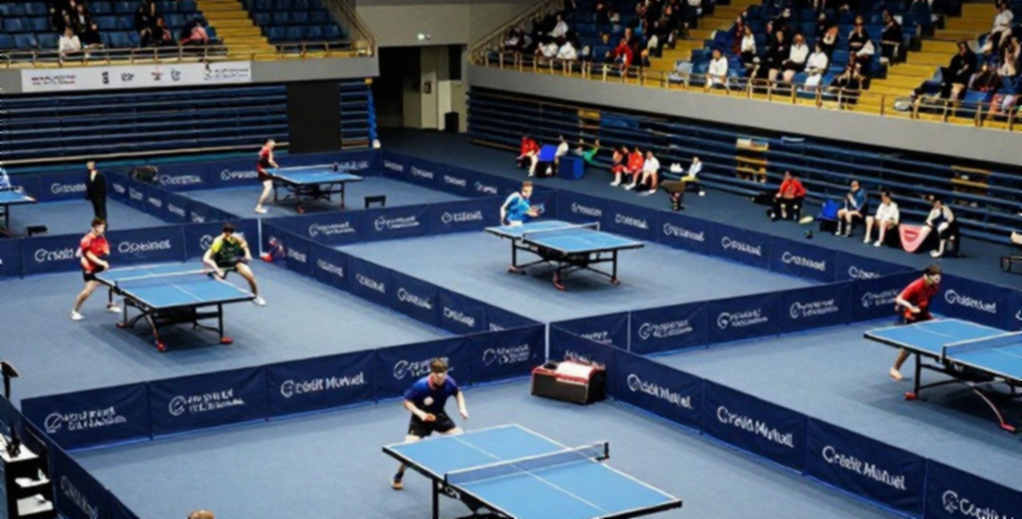
The location matters. Katy, Texas, a Houston suburb, hosted the event. Many reports skip this detail, but for anyone working with data it is a variable that cannot be erased. The host delegation played in a familiar hall, with no long travel, no time-zone shift, home crowd support and the invisible psychological edge every youth event carries. Add the tendency of host nations to send large, well-prepared delegations, and their medal share is mechanically inflated.
The program covers 14 events: seven U13 and seven U11. Each event normally awards one gold, one silver and two bronzes, because both semifinal losers receive bronze with no bronze-medal match. Fourteen events times four medals equals exactly 56, which matches the published figure. That arithmetic confirms the tournament structure on its own and lets me read further.
Its place in the system carries no senior ranking points and no Olympic quota. Its value lies in the development pipeline: it feeds U15 and U19 identification and future world-junior qualification. Reading that correctly avoids two errors at once: treating it as meaningless, and inflating it into a measure of national table tennis strength.
The evidence chain and the cross-check
If there are 14 events and each has exactly one gold, the total available gold is 14. The United States won 14. That means they won every event without missing a single final. This is a far stronger statement than the 76.8 percent medal share, because it does not depend on delegation size. An event has only one champion, and the host took them all.

The core point sits here: the U.S. U13 squad swept all seven U13 events, and every one of the tournament's 14 golds went to the host nation.
The bronze line also fits the dual-bronze structure. If all 14 events award two bronzes, 28 are available. The United States took 18, roughly 64 percent. That share is lower than the gold share, a telling detail: other delegations still reached semifinals in many events, yet almost none crossed the host in a decider. Descriptively, that is the picture of a team with superior depth at the decisive moment, while the rest of the region could only reach the semifinals.
Based on my experience tracking youth events, a team sweeping continental gold at the youngest brackets usually reflects three stacked factors. First, a more even technical base, typically from a denser private-academy system and diaspora coaching pool than most Central and South American nations have at the same age. Second, squad depth: when one event has several players of similar level, the probability that at least one reaches the final rises sharply. Third, home-field advantage, still the most underrated factor in results reporting.
U.S. national team coach Tim Wang is the only person named in the entire report. He spoke of focus, of overcoming adversity and fighting for every point. That is psychological language, not technical language. A youth coach speaking about mentality is normal and correct, but an analyst must draw the line clearly: a statement about mentality cannot be converted into a conclusion about a technical system. It only tells us the team was well prepared psychologically, which every champion team is.
One detail needs to be stated plainly: in a report about 43 medals, not a single athlete is named. That is a deliberate communications choice, usually to shield very young competitors from pressure and to direct attention to the program rather than individuals. Analytically, it closes off any athlete-level assessment. I cannot say anything about the technique of a player whose name I do not know.
The only conclusion the data permits therefore sits at program level, not human level. If the U13 squad won all seven events, then in that exact age bracket, in that exact region, this group's foundation sat one tier above the rest of the field. That is a result-level inference, not a technique-level one. Its confidence is low, and I mark it as such.
When the market panics, only the index keeps the breathing rhythm. There is no market panic here, but there is another kind: media excitement at a flattering medal table. Readers need an anchor, and the correct anchor here is tournament structure, not a percentage.
The counterintuitive angle: a regional bubble named home field
What the medal table does not say is where this event sits on the world map. It is a continental championship, not a world championship. The opponents are Americas federations, not China, Japan, South Korea or the European table tennis nations. A 76.8 percent medal share at continental U11-U13 level says regional dominance at the youngest tier, which is entirely different from being competitive at world level.
Correlation is not causation. That the host won many medals and that the host has a better foundation are two hypotheses coexisting, and the available data cannot separate them. Had the event been held in Brazil or Canada, the U.S. medal share would almost certainly have been lower. Had the opponents been Asian table tennis nations, this figure would not exist in this form.
The history of Pan-American table tennis shows a clear pattern: regional youth dominance rarely converts into senior world-level depth, except in isolated cases such as Brazil's senior stars. Most U11-U13 champions never reach the international summit. The barrier is the dropout rate when players enter U15 and U19, the phase when school pressure and competition from school sports bite hardest. A U13 gold is a signal of potential, not a promise of results.
Data provenance also deserves mention. The figures 43, 14, 11, 18 and 56 are not tied to any independent verification and most likely come from a federation self-published release. That is a reporting-quality flag, not a question of right or wrong. The internal arithmetic fits perfectly, which strengthens confidence in the structure, but it should still be checked against official ITTF Americas records before being cited.
The silence about other delegations is itself data. The remaining 13 medals were scattered across several smaller associations, with no delegation emerging as a clear counterweight. Such a thin regional field is precisely the condition that lets a host nation sweep the golds. Had Brazil or Puerto Rico fielded a strong U13 generation, a 14-for-14 sweep would not have happened.
Pieces worth tracking from here
At 43, I still dig for the pieces the market forgets. The piece worth tracking here is not the Katy medal table but the fate of this U13 cohort over the next three years. The signal to watch is concrete: whether any player from this group appears at continental U15 and U19 events or world junior championships. If they do, the U.S. youth program has proven real depth. If not, Katy was a beautiful moment at home.
The second signal sits on the opponent side. If Brazil, Canada or Puerto Rico close the gold gap in coming editions, we will know the sweep reflected a weak field rather than a leap forward. The third signal is hosting. If ITTF Americas keeps placing youth events on U.S. soil, a domestic youth competition circuit will gradually form, and that is the durable industry effect, worth far more than any single medal.
Table tennis never follows emotion, but it always follows probability. A tournament in Katy handed out 56 medals, and the host took 43. That number is correct. The remaining question sits in how many of those 43 medals will still be standing on a table three years from now.